Serving Laurel, MD and Nearby Area
Commercial Water Damage Restoration in Laurel, MD
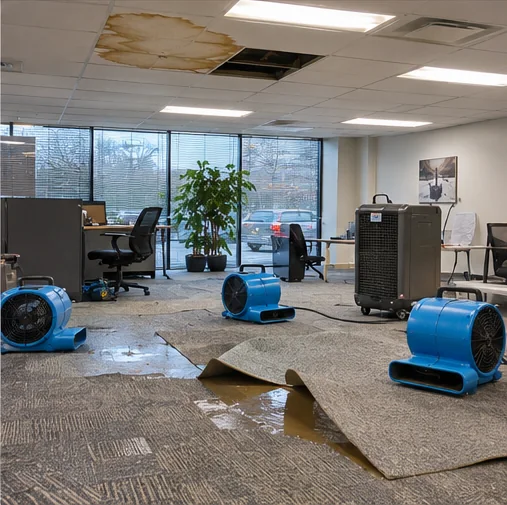
A water loss in a business comes with a clock on it. We map the wet areas, pull out the water and what cannot dry, and plan the work around how the space is used.
Call (301) 786-0888See pricing
- Offices, shops, rental units and small commercial buildings
- Moisture map that includes adjacent units and the rooms above and below
- Readings and photos logged for your insurer and landlord
- Emergency calls taken 24 hours a day
What changes when the building is not a house
The water is the same. The job around it is different.
- More people are involved. Owner, tenant, property manager and insurer may all need information.
- Floors are bigger and layered. Commercial carpet tile, glue-down flooring, raised floors and slab-on-grade behave differently from residential flooring.
- Systems matter. Ceiling tiles, sprinkler lines, HVAC drains and shared walls between units all add routes for water.
- Occupancy is a factor. The work is planned around how the space is used, as far as safety allows.
Where commercial losses start and what slows the reopening
| Type of space | Common source | What usually slows the reopening |
|---|---|---|
| Office | Supply line, roof leak, HVAC drain overflow | Ceiling tile and carpet tile replacement, electronics, records |
| Retail or restaurant | Water heater, dishwasher line, grease trap overflow | Inventory, food-handling rules, floor finishes that cannot be dried in place |
| Apartment or rental unit | Unit above, shared riser, appliance | Multiple units affected, tenant access, shared walls |
| Storage or light industrial | Roof drain, sprinkler discharge, slab seepage | Stored goods, pallets on wet slab, large floor area |
How commercial water damage restoration is phased in Laurel, MD
Stabilize
Stop the source, make the area safe and extract standing water. If power or sprinklers are involved, the building engineer or utility is brought in.
Map and scope
Moisture readings go on the floor plan, including adjacent units, rooms above and below, and the ceiling cavity. Scope is written around what has to be opened, not what is easiest.
Protect what can be protected
Furniture is lifted or moved, equipment and files are relocated, and the dry parts of the space are separated from the work area where practical.
Remove and dry
Wet ceiling tile, insulation and floor coverings that cannot be saved come out. Air movers and dehumidifiers go in across the whole wet footprint.
Monitor and report
Daily readings are logged against the first map. A running record goes to whoever needs it, owner, property manager or adjuster.
Business water loss?
Call with the address, the type of space and what is wet. We will tell you what the first visit looks like.
Call (301) 786-0888Documents your insurer and landlord may ask for
A commercial claim often comes with paperwork. Having it organized from day one avoids arguments later.
- Moisture readings with dates and locations.
- Photos before, during and after the work.
- A list of materials removed, by room.
- Equipment logs showing what ran and for how long.
- Your own list of damaged contents and the time you discovered the water.
We keep the first four as part of the job. The last one is yours to start.
What a manager can do before the crew arrives
- Get people out of the affected area and keep them out of any room where water reaches electrical equipment.
- Shut the water to the fixture or the building if you can do it safely.
- Move inventory, paper files and computers up off the floor.
- Tell the tenants or staff who need to know. A short note beats rumors.
- Call your insurer and your landlord or management company, whichever applies.
A longer checklist is in our post on a water loss checklist for small businesses and property managers.
Mistakes that make a business loss more expensive
Most of them come from trying to help.
- Running the HVAC with wet ceiling tiles above it. That moves moisture, and sometimes mold spores, to other rooms.
- Stacking dry inventory on a damp slab, where the bottom layer wicks water.
- Throwing out wet materials before they are photographed or logged, which leaves nothing for the adjuster to look at.
- Waiting for the owner or the insurer to approve before calling anyone. Extraction can start while the paperwork catches up.
Signs the loss is bigger than the visible spot
- Ceiling tiles are stained in a line that follows a pipe.
- Carpet tile edges are curling or the glue is letting go.
- Walls in the next unit or the room below feel cool or damp.
- A musty smell hangs in the HVAC supply.
- Baseboard or cove base is lifting along a whole wall.
How much does commercial water damage cost?
Commercial losses range from a wet back room to a whole floor of a building, so the numbers below are estimated starting ranges for single pieces of the work. They are not final prices, and the number for your building is set after we take readings on site.
| Service | Estimated range | What it covers |
|---|---|---|
| Emergency water extraction, small space | $800 to $2,500 | Pumps and extractors on standing water, one visit |
| Structural drying and dehumidification | $1,500 to $6,000 | Air movers, dehumidifiers and daily readings until dry |
| Wet ceiling tile, insulation and drywall removal | $1,000 to $4,000 | Cutting out and hauling away what cannot dry in place |
| Carpet tile or flooring removal | $800 to $3,500 | Lifting and disposing of wet floor coverings |
| Sewage backup cleanup, small unit | $3,500 to $10,000 | Removal, cleaning and sanitizing of Category 3 water |
| Mold removal, small contained area | $1,500 to $5,000 | Containment, removal and HEPA cleaning |
| Whole small commercial loss, extraction through drying | $3,000 to $20,000 or more | Several rooms or a full unit, start to finish |
What moves a commercial price up or down:
- Floor area that is actually wet, not the size of the building.
- Water category. Gray and black water add removal, cleaning and protective gear.
- Finishes. Suspended ceilings, carpet tile and glue-down flooring each take different labor.
- Units or floors affected, including neighbors above and below.
- Drying days, which depend on slabs, framing and how long the water sat.
- Access and timing, such as work around business hours.
- Mold, which is separate work from drying.
The pricing page has general ranges for residential jobs and the factors behind them.
Commercial water damage restoration questions
Can the business stay open during drying?
Sometimes. If the wet area can be separated and the air is not contaminated, partial occupancy works. If the water was gray or black, or the area is large, the space typically needs to close.
Do you work outside normal business hours?
Emergency calls are taken 24 hours, and work can be scheduled around how the space is used. Tell us when the building is empty and we will plan around it.
Who pays, the tenant or the owner?
That depends on the lease and on the source of the water. We document the loss and leave the question to you, your landlord and the insurers.
What about a water loss in a unit above or below mine?
Water crosses unit lines through floors, walls and shared risers. We map each affected unit, since it can be a separate scope in each.
Do you work on large buildings?
We handle small commercial buildings and individual units. Very large losses may involve other contractors, and we will say so up front.
Other jobs that come with this one
- Emergency Water Extraction Pumps and extractors on large floor areas.
- Structural Drying & Dehumidification How wet slabs and walls are dried.
- Mold Removal If moisture has been sitting in a closed building.