
West Laurel, Prince George's County
Water Damage Restoration in West Laurel, MD
West Laurel is mostly older single-family houses on wooded lots, where gutters, crawlspaces and long-held equipment fail first. We pump, dry and remove what cannot be saved.
Call (301) 786-0888See our services
- Crawlspace and basement water
- Ice dams, gutter leaks and frozen lines
- Extraction, removal and drying
- Emergency calls taken 24 hours a day
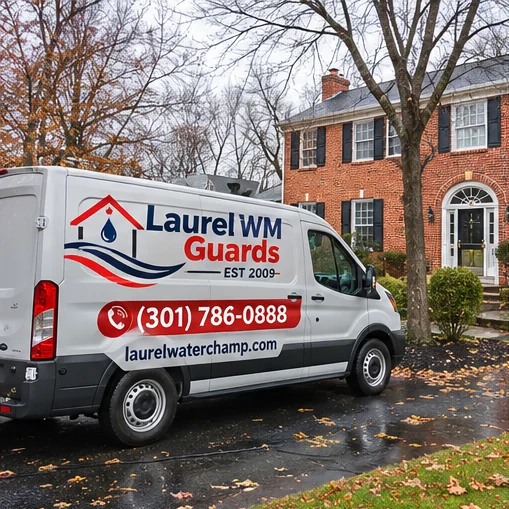
Our water damage restoration, extraction & drying services in West Laurel, MD
These are the services we offer in West Laurel, MD, where most of the housing is older and single-family.
Extraction through drying for West Laurel's older single-family houses.
Pumps and extractors for basements and crawlspaces.
Hose bibs and crawlspace lines that freeze first.
Small commercial space along MD 198.
Mold after a leak in closed-up rooms and crawlspaces.
Seepage and sump failures on wooded lots.
Damp framing under 1960s-era floors.
Slow-drying framing brought down to readings.
Backups from older laterals, cleaned and sanitized.
Ice-dam and gutter leaks that reach the ceiling.
Runoff from heavy rain on sloped, wooded lots.
Original equipment in houses held for decades.
West Laurel was built once and mostly left alone
In its 2010 plan, using 2006 figures, Prince George's County described West Laurel as a community of about 4,500 people, bounded on the north by the Rocky Gorge Reservoir, on the east by the City of Laurel and I-95, on the south by MD 198 and on the west by Montgomery County. It has roughly 1,600 housing units, nearly all of them single-family detached homes, and homeownership near 95 percent. There are no street lights and few through streets, and residents told planners they like it that way.
The plan says about 85 percent of the homes were built before 1980, and nearly half of those in the 1960s. A house that age has had a long run, and the parts that wear out do so on a schedule.
What wears out in West Laurel houses, by era
| Before 1980: about 85% | 15% |
- Built before 1980. Nearly half of these were built in the 1960s.
- Built in 1980 or later
At that age the usual failures are water heaters, supply lines and shutoff valves, washer hoses, roof flashing and gutters, crawlspace and basement moisture, old sump pumps and hose bibs that were never frost-proof.
Trees, wooded lots and what they do to a house
Residents told county planners they value the mature trees and the country feel of West Laurel. Trees are good for the neighborhood and hard on gutters. Leaves in a gutter turn it into a dam, and the water that should leave the roof spills at the wall instead. Over a few seasons that can put water at the foundation, and in winter it freezes into the ice dams that push water under shingles. A leak that starts at the roof edge ends up as a stain on a ceiling.
Roots do the same kind of slow work underground. A mature tree near an old sewer lateral can push into a joint and slow the flow until the line backs up. For the ceiling side, see ceiling and drywall water damage. For the winter side, read the post on ice dams and ceiling leaks.
Water in a West Laurel house?
Street, floor and where the water started are all we need to begin.
Call (301) 786-0888Crawlspaces, basements and the lines in them
Houses from the 1960s can have crawlspaces or partial basements, so check yours. Many older crawlspaces were not built with sealing in mind, and the plumbing in them is exposed to whatever the weather does. A supply line under the floor, a hose bib that was never frost-proof, a water heater in a corner: these are the places where a winter freeze or a summer drip shows up first.
Standing water and damp framing under the house are the subject of crawlspace water removal and drying. If a freeze has already broken a line, see frozen and burst pipe cleanup. To head it off, the post on keeping pipes from freezing lists what to do before the cold arrives.
Rocky Gorge, the Duckett Dam and the Patuxent
The reservoir at the north edge of West Laurel was created by the T. Howard Duckett Dam on the Patuxent River. It belongs to the Washington Suburban Sanitary Commission, WSSC Water, and the county plan describes it as a source of raw water for Montgomery and Prince George's counties. Water from the reservoir is pumped to a filtration plant in Laurel, and some of the surrounding land is open to the public for fishing, boating and trails.
Living near a reservoir does not by itself mean a basement floods. What it does mean is that a lot of land near West Laurel is protected, wooded and managed for water supply. The plan says the Patuxent corridor and the reservoir are conservation areas. That keeps the neighborhood quiet. It also means the ground around you is soaking up rain that, in a built-up area, would be running off pavement.
Mold in houses that stay closed up
A house of that age can have the weak points that feed mold: a bathroom without a working fan, a damp crawlspace, a basement that stays cool and humid all summer. Mold needs moisture and time, and it can start growing in 24 to 48 hours on wet materials. If you find a musty smell or a stain after a leak, do not wait for it to clear on its own. Mold removal shows what containment looks like and what not to do before the crew arrives.
Basement water on a wooded lot
The plan says West Laurel's open space and large wooded areas are among the community's biggest strengths. For a basement, a wooded lot has a mixed effect. Roots take up water and trees slow rain on its way down, but leaf litter blocks drains and window wells, and a storm can still send runoff to the lowest corner of the yard. If your basement takes water, start with the downspouts and the grade, then check the sump pump. If it has already come in, basement flood cleanup shows what we do.
Details that help us find the house
- Your street and the nearest cross street. Many West Laurel streets are quiet and lightly marked, and there are no street lights to help a crew find the house at night.
- The floor and room the water is in, and whether it is still coming.
- Whether the heat is on, if it is winter.
- A porch light on and a clear path to the door.
Houses that stay in the family
County planners heard from West Laurel residents that many generations of families have stayed in the area, with very little turnover. That is good for a neighborhood and has a plain effect on a house. Equipment gets used until it quits. A water heater that was installed by the original owner is still in service, a washing machine hose has not been changed in a decade, and the shutoff valves under the sinks have not been turned in years, so they stick or leak when someone finally tries them. If you are the second owner of a house that old, spend an afternoon replacing the rubber hoses and turning each valve. A good place to start is the post on water heater leak warning signs. When something does fail, appliance and water heater leak cleanup is the cleanup.
Services most West Laurel calls involve
- Crawlspace Water Removal & Drying Standing water and damp framing.
- Frozen & Burst Pipe Cleanup Winter breaks in older lines.
- Mold Removal After a leak sits too long.
- Basement Flood Cleanup Seepage and failed sump pumps.
Along MD 198
- Burtonsville Montgomery County, along the same MD 198 corridor to the west.
- South Laurel Prince George's County, on the other side of the City of Laurel.